

Minimalist Fitness Tracker: 4 Best Minimalist Fitness Trackers in 2026
Compare four of the best minimalist fitness trackers — including screenless fitness tracker options — for steps, sleep, heart rate, GPS, and recovery.
The Best Minimalist Fitness Trackers at a Glance
| Fitness tracker | Best for | GPS | Display | Advertised battery life |
|---|---|---|---|---|
| Google Fitbit Air | Best overall screenless fitness tracker | No | No screen | Up to 7 days |
| Garmin vívosmart 5 | Simple everyday tracking | Connected through phone | Small band display | Up to 7 days |
| Fitbit Charge 6 | Heart rate and polished tracking | Built in | AMOLED screen | Up to 7 days |
| Amazfit Helio Strap | Screenless fitness tracker for training | No | No screen | Up to 10 days |
Somewhere along the way, fitness trackers started trying to become small phones.
They added calls, apps, payments, message replies, music controls, readiness scores, stress scores, coaching subscriptions, and enough charts to make a normal Tuesday feel like a medical research project.
Those features can be useful. They can also be exactly what you are trying to avoid — which is why interest in a screenless fitness tracker has grown. If you want health data without another glowing display on your wrist, a screenless fitness tracker keeps the sensors and drops the interface.
1. Google Fitbit Air: Best Screenless Fitness Tracker Overall
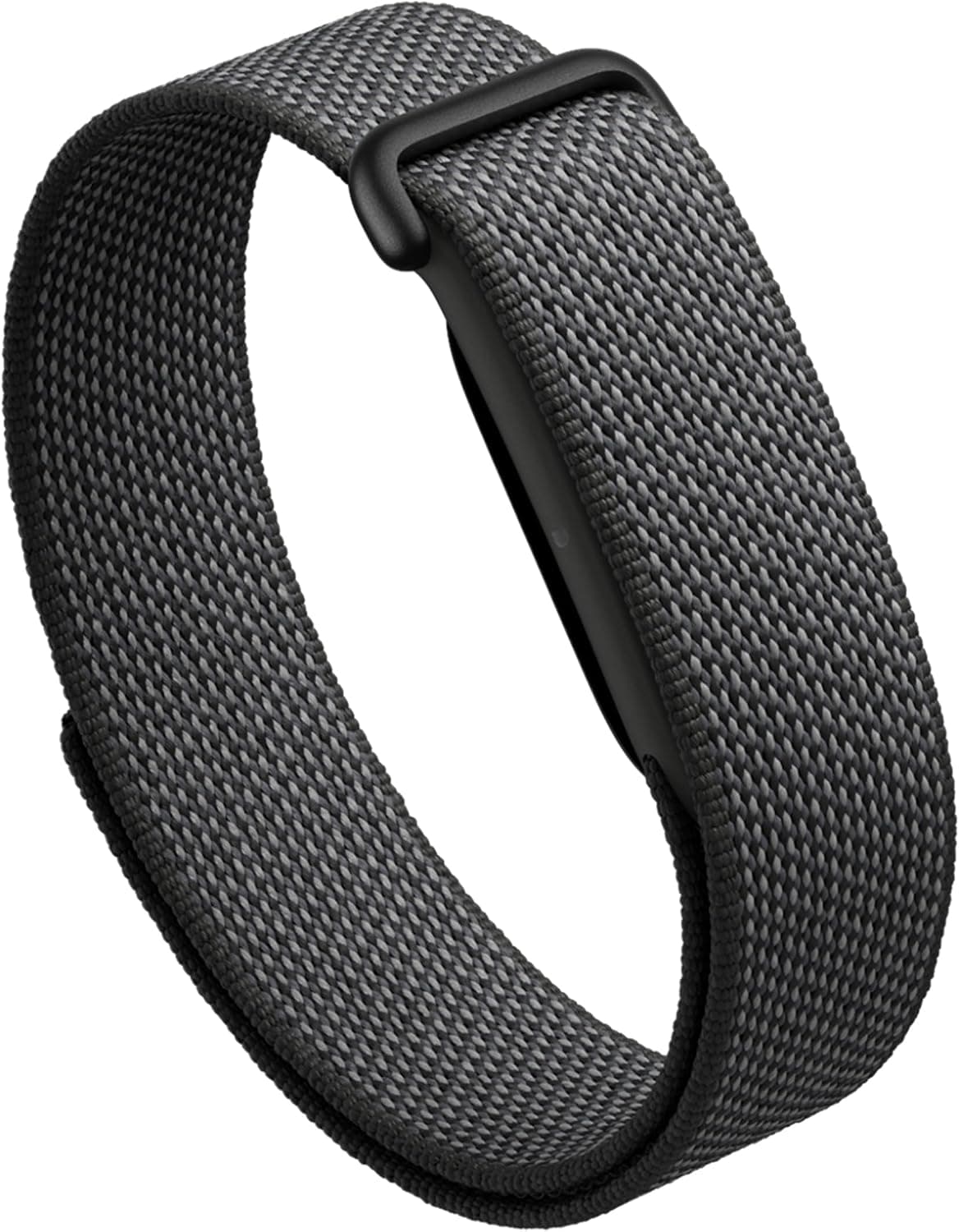
The Google Fitbit Air is the closest match for someone who wants a minimalist fitness tracker without another screen on their wrist. Put simply, it is a screenless fitness tracker built for quiet, all-day wear.
It is a small “pebble” tracker designed for 24/7 use. There is no clock face, no notification centre, and no smartwatch interface competing for attention. You check your data in the Google Health app when you want it, and leave the device alone the rest of the time.
Fitbit Air tracks steps, distance, calories, active zone minutes, continuous heart rate, heart-rate variability, SpO2, sleep stages, and related recovery signals such as Cardio Load and Readiness. It can also look for irregular heart rhythms and send AFib alerts. Google advertises up to a week of battery life, with a short fast-charge option when you need a quick top-up.
That combination makes it one of the strongest screenless fitness tracker options in this list. If your idea of a minimalist fitness tracker is serious health data with almost no interface, Fitbit Air fits that brief.
The important trade-off is the missing display and GPS.
Because there is no screen, you will not glance at the time, live pace, or heart-rate zones during a workout. Outdoor route mapping depends on your phone and the Google Health app rather than hardware inside the band. That may be exactly what you want from a screenless fitness tracker. It is less ideal if you want on-wrist feedback while you run.
Core activity and health data are available without a paid plan. Google Health Premium adds coaching features built with Gemini, and Fitbit Air includes a trial, but the device itself is not a subscription-only bracelet.
The Fitbit Air is a good fit when you want:
- A screenless fitness tracker for wrist wear
- Heart-rate, sleep, and recovery tracking
- Automatic activity detection
- A low-profile band you can wear all day and night
- Core health data without a required subscription
It is less suitable when you need built-in GPS, a clock, live workout feedback, or on-device controls.
Best for: Someone who wants a screenless fitness tracker with almost no on-wrist interface.
2. Garmin vívosmart 5: Best Simple Everyday Fitness Band
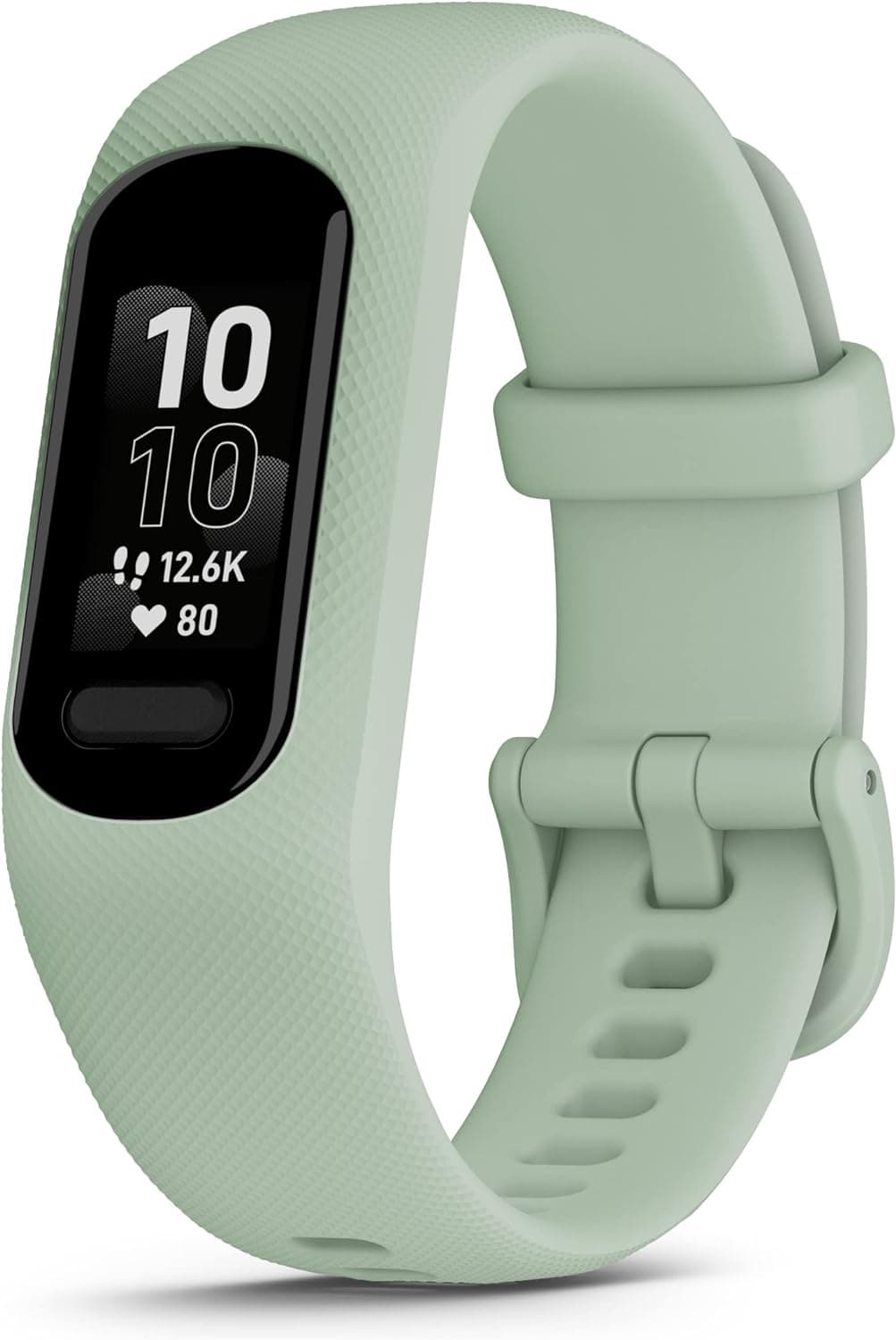
The Garmin vívosmart 5 is closer to the traditional idea of a minimalist fitness tracker: a narrow band with a small display, not a smartwatch pretending to be one.
It has physical button controls and up to seven days of advertised battery life. It tracks everyday information such as steps, calories, intensity minutes, heart rate, sleep, stress, respiration, and Garmin’s Body Battery estimate.
Garmin positions the vívosmart 5 as an easy-to-use alternative to a smartwatch. That is an accurate way to think about it. You get the company’s health and activity platform without wearing a large watch face or adding another app ecosystem to your wrist.
The important limitation is GPS.
The vívosmart 5 uses connected GPS. It relies on the GPS antenna in your phone to record location, distance, and speed during outdoor walks, runs, and bike rides. Your phone therefore needs to be with you when you want a mapped route.
That may not matter when you already carry your phone. It matters a lot when the reason you are buying a new tracker is to leave your phone at home.
The vívosmart 5 is a good fit when you want:
- A narrow fitness-band design
- Steps, heart rate, sleep, and activity tracking
- A simple on-device display
- Garmin’s health and fitness platform
- GPS only when your phone is nearby
There is still plenty of information available inside Garmin Connect, but the tracker itself remains fairly restrained. You can also reduce or disable phone notifications to stop it from becoming another source of interruptions.
Best for: Everyday activity and health tracking when you usually carry your phone.
3. Fitbit Charge 6: Best for Heart Rate and a Polished App
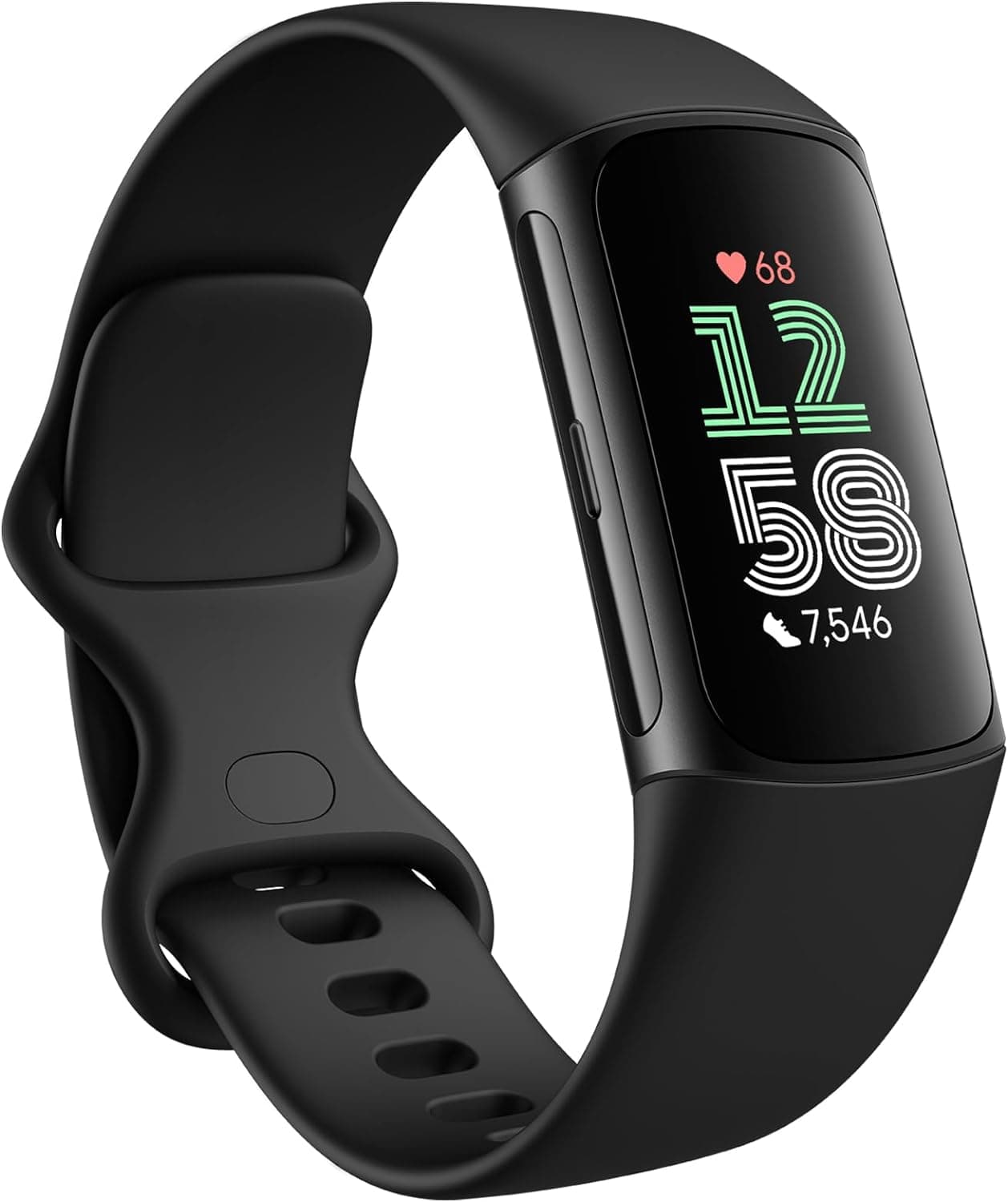
The Fitbit Charge 6 sits somewhere between a simple fitness band and a small smartwatch, so it is a less extreme minimalist fitness tracker than a true screenless fitness tracker like Fitbit Air or the Helio Strap.
It includes continuous heart-rate tracking, built-in GPS and GLONASS, sleep tracking, workout tracking, steps, distance, and calorie estimates. Google advertises up to seven days of battery life, although features such as the always-on display and blood-oxygen monitoring can require more frequent charging.
Fitbit’s biggest strength is how approachable the information feels.
You do not need to understand training-load formulas to see whether you walked more, slept longer, or spent time in a higher heart-rate zone. The Charge 6 can also display live heart-rate information on compatible treadmills, ellipticals, rowing machines, and exercise bikes.
It has more smart features than the Garmin, Fitbit Air, or Amazfit Helio Strap. Google Maps, Google Wallet, YouTube Music controls, and phone notifications are available. Those additions may be useful, but they make the Charge 6 less minimal once everything is enabled.
The device can still feel simple when you configure it carefully. Disable the notifications you do not need, choose a plain clock face, and use the tracker primarily for activity, heart rate, sleep, and GPS.
Some deeper Fitbit or Google Health experiences may be connected to paid services, depending on the feature and region. The core device still tracks workouts, heart rate, steps, distance, sleep, calories, and GPS without requiring you to subscribe simply to record those basics.
The Fitbit Charge 6 is a good fit when you want:
- Built-in GPS
- Detailed heart-rate tracking
- A slim band rather than a full watch
- An approachable health and fitness app
- Optional smart features
It is less appealing when you want to avoid premium features, Google services, and smartwatch-style additions entirely.
Best for: Someone who values heart-rate tracking, built-in GPS, and an easy-to-understand app experience.
4. Amazfit Helio Strap: Best Screenless Fitness Tracker for Training
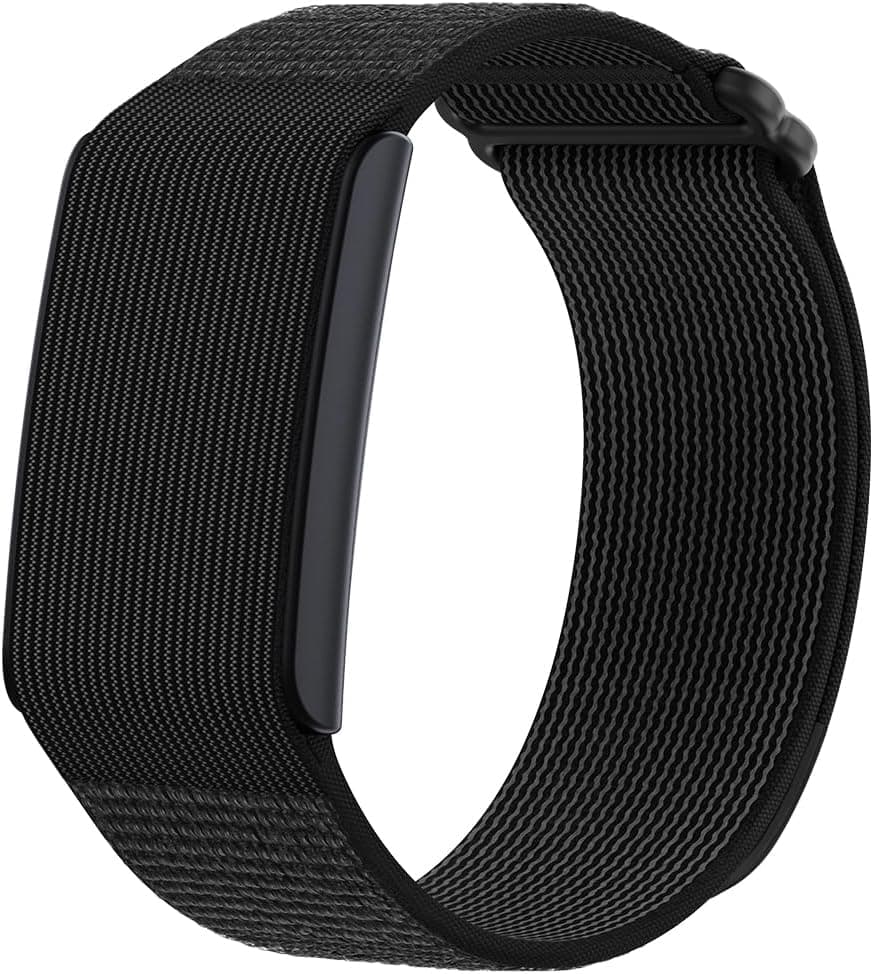
The Amazfit Helio Strap takes a different approach from the display-based options, and it is a strong screenless fitness tracker if you care about training and recovery rather than a watch face.
There is no clock face, notification centre, or collection of apps on your wrist. It is a lightweight strap designed to collect training, sleep, and recovery information while staying out of the way. You can wear it on the wrist for everyday use or on the upper arm during harder workouts for more stable heart-rate tracking.
The Helio Strap monitors continuous heart rate, heart-rate variability, sleep, stress, blood oxygen, skin temperature, and activity load. It uses this information to generate readiness and recovery insights inside the Zepp app, and it supports a range of sports modes for strength training and other workouts. Amazfit also positions it as part of a broader ecosystem that can sit alongside an Amazfit watch or Helio Ring.
At about 20 grams, it is light enough for all-day and overnight wear. It is rated 5 ATM for water resistance, and Amazfit advertises up to 10 days of battery life — one of the longest claims in this comparison.
It is a strong subscription-free alternative to pricier screenless fitness tracker options. There is no screen lighting up during dinner and no stream of smartwatch interruptions.
That also creates its biggest limitation.
You cannot glance at the Helio Strap to check the time, view live pace, or follow a mapped route on the device itself. It does not have built-in GPS. Most of the useful information lives inside the Zepp app, and outdoor route tracking depends on your phone when you need it.
The Helio Strap is therefore better suited to continuous health, training load, and recovery tracking than on-wrist workout guidance. It makes the most sense for someone who wants a screenless fitness tracker with longer battery life and no required membership.
Amazfit’s current US product page promotes the Helio Strap’s health, sleep, and training features without requiring an additional subscription. Services and availability can vary by region, so it is still sensible to check the terms shown in your local Zepp app before buying.
The Helio Strap is a good fit when you want:
- A screenless fitness tracker for wrist or arm wear
- Sleep, recovery, and training-load tracking
- Heart rate, HRV, blood oxygen, and stress information
- Longer battery life without a smartwatch
- No required subscription
It is less suitable when you need GPS, a clock, live pace, or workout information visible during exercise.
Best for: Someone who wants a screenless fitness tracker focused on training and recovery, without a subscription.
Why Get a Minimalist Fitness Tracker at All?
What are you actually trying to track?
A minimalist fitness tracker can tell you how many steps you took, where you ran, how your heart rate changed, and whether it thinks you slept well.
That data is useful when you have a specific reason to use it. A runner may want accurate routes and pace. Someone working on their sleep may want to notice longer-term patterns. A person managing training intensity may care about heart rate and recovery.
For many people, though, the hardest part of fitness is not measuring the workout.
It is doing the workout again next week.
You probably already know whether you exercises. You know whether you went for the run, finished the class, or did the workout at home. The problem is creating enough momentum to keep doing it.
That is why Huddle takes a simpler approach.
Every time you show up, take a photo and post it.
That photo becomes a record of the workout. You do not need to enter every exercise, count every calorie, or review six different recovery scores. You open Huddle, capture the moment, and move on.
Over time, those photos create a visual history of your consistency. You can look back and see whether you trained once this month or three times this week. The record is easy to understand because it reflects something real that happened.
You showed up.
Huddle can also be used with a small group of people you know, but the basic value does not depend on turning every workout into a competition. The photo itself creates a small moment of accountability and gives you something to build on.
A heart-rate graph cannot make you go to the gym. A readiness score cannot complete the workout for you. Sometimes the most useful minimalist fitness tracker — or even a screenless fitness tracker — is the one that keeps the focus on the behaviour you are trying to repeat.
Which Minimalist Fitness Tracker Should You Choose?
The right minimalist fitness tracker depends on what you are trying to remove. If you specifically want a screenless fitness tracker, focus on Fitbit Air or the Helio Strap.
Choose the Google Fitbit Air when you want a quiet screenless fitness tracker focused on health and activity data in the app.
Choose the Garmin vívosmart 5 when you want a narrow everyday fitness band and do not mind carrying your phone for GPS.
Choose the Fitbit Charge 6 when you care about heart-rate tracking, built-in GPS, and an app that makes the information easy to understand.
Choose the Amazfit Helio Strap when you want a screenless fitness tracker for training and recovery, with longer battery life and no required subscription.
Choose Huddle when you do not need another wearable at all and mainly want to become more consistent.
None of these options is perfectly minimal in every way.
A device with built-in GPS needs more hardware and battery power. A tiny band may need your phone to map a route. A smart ring can disappear into your day, but it cannot show live information. A polished health platform may place some coaching or analysis behind a paid service.
The useful question is not which tracker has the fewest features.
It is which one has the fewest features you do not want.
A Photo Can Be Enough to Track a Workout
Fitness companies have become very good at measuring what happens around a workout.
They measure your sleep before it, your heart rate during it, your recovery after it, and your estimated readiness to do another one.
But the most important event is still the workout itself.
You either showed up or you did not.
That is what makes a photo surprisingly useful as a fitness record. It captures the behaviour that matters without asking you to turn exercise into data entry.
Take a photo at the gym. Take one after your run. Post the yoga mat on the floor, the trail you reached, or the dumbbells you used at home.
The photo does not have to be impressive. It only has to represent something you completed.
When you post those moments to Huddle — after starting your first group — they begin to form a simple visual calendar of your activity. You can see the quiet weeks, the strong weeks, and the point where going occasionally started turning into a routine.
This also gives you something that most wearables do not.
Context.
A step count cannot tell you that you finally returned to the gym after a difficult month. A heart-rate chart cannot show that you worked out before an early meeting because you had promised yourself you would. A calorie estimate cannot capture the friend who got you out the door.
A photo can.
What to Look for in a Minimalist Fitness Tracker
Before you buy a minimalist fitness tracker, decide which features you will actually use after the novelty wears off.
The Metrics You Will Actually Use
It is easy to shop by feature count. It is more useful to think about the handful of numbers you will still check after the first month.
For many people, that means steps, workout duration, heart rate, sleep, and distance.
Everything else may be interesting without changing what they do next.
Start with the essentials. Treat the rest as optional.
Built-In GPS or Connected GPS
Built-in GPS lets the tracker record an outdoor route without relying on your phone.
Connected GPS uses your phone’s location data. It can still provide a useful route and pace estimate, but the phone needs to come with you.
This distinction is easy to miss on a product page and frustrating to discover during your first phone-free run.
Battery Life
A tracker cannot build a complete picture of your activity or sleep while it is charging.
Long battery life also makes a device feel less demanding. Charging once every week or two is easier to forget about than adding another object to your nightly charging routine.
Remember that advertised maximums usually come from controlled test conditions. GPS, continuous monitoring, bright displays, and frequent notifications can reduce real-world battery life.
Subscription Requirements
Some trackers work without a subscription but reserve coaching, recovery analysis, historical reports, or deeper insights for a paid tier.
That is different from requiring a subscription to use the hardware, but it can still change the experience.
Check which specific features work without paying every month, especially when a readiness score or sleep report is one of the reasons you are considering the product.
Size and Comfort
A tracker that looks small in a product photo can still become annoying during sleep or strength training.
Look at its weight, width, thickness, band shape, and how far it sits above the wrist or finger. A comfortable device you wear consistently will collect more useful information than a more advanced one you regularly remove.
Notifications
A minimalist fitness tracker can be physically small while still creating the same distractions as a smartwatch.
Most bands let you limit or disable phone notifications. Doing that during setup may be the single best way to make the device feel simpler.
A screenless fitness tracker avoids the problem entirely because there is no display to light up.
Do You Need Heart Rate, Sleep Scores, and GPS?
It depends on what you plan to do with the information from your minimalist fitness tracker. A screenless fitness tracker still collects heart rate, sleep, and activity data — it just shows that information in an app instead of on your wrist.
Heart-rate data can help you understand workout intensity. GPS is genuinely useful for runners, cyclists, and hikers who want to see routes, distance, or pace. Sleep tracking may reveal patterns worth paying attention to over several weeks.
The data becomes less useful when checking it becomes the entire habit.
A low readiness score may encourage you to skip a workout you could have completed comfortably. A disappointing sleep score can make you feel tired before you have considered how you actually feel. An inaccurate calorie estimate may create a sense of precision that the device cannot fully provide.
A minimalist fitness tracker is still a consumer wellness device, not a medical instrument. Look for patterns rather than treating each daily number as a verdict.
And remember that none of those measurements replaces consistency.
A person who works out regularly without tracking heart rate will usually make more progress than someone who owns an advanced tracker but rarely trains.
Minimalist Fitness Tracker FAQ
What is a minimalist fitness tracker?
A minimalist fitness tracker records essential activity or health information without functioning like a full smartwatch. It usually focuses on steps, workouts, heart rate, sleep, time, recovery, or GPS while limiting apps and other distractions.
A screenless fitness tracker such as the Google Fitbit Air or Amazfit Helio Strap takes the idea further by moving all information into a companion phone app.
What is a screenless fitness tracker?
A screenless fitness tracker is a wearable that collects health and activity data without a display on the device itself. There is no clock face, notification screen, or on-wrist workout UI — just sensors, a band or strap, and an app.
What is the best minimalist fitness tracker with GPS?
The Fitbit Charge 6 is the strongest GPS option in this comparison because it includes built-in positioning hardware.
The Garmin vívosmart 5 uses connected GPS, while a screenless fitness tracker such as the Google Fitbit Air or Amazfit Helio Strap does not include GPS.
What is the best screenless fitness tracker?
Both the Google Fitbit Air and Amazfit Helio Strap qualify as a screenless fitness tracker. Choose Fitbit Air if you want a quieter Google Health-focused pebble; choose the Helio Strap if you want longer advertised battery life, training-load insights, and optional upper-arm wear.
Both focus on sleep, heart rate, recovery, and activity data in an app rather than displaying workout information on the device.
Can you get a minimalist fitness tracker without a subscription?
Yes. Garmin provides its core tracking platform without requiring an ongoing subscription. The Fitbit Charge 6 and Google Fitbit Air also record basic activity and health information without requiring a premium membership, although Google Health Premium can add coaching features.
Amazfit’s US Helio Strap page currently promotes its health, sleep, and training experience without an added subscription, although services may vary between regions.
Which minimalist fitness tracker is best for sleep?
The Amazfit Helio Strap and Google Fitbit Air are the strongest sleep-focused options because each is a lightweight screenless fitness tracker designed for overnight wear.
The Garmin vívosmart 5 and Fitbit Charge 6 also provide sleep tracking.
Which simple fitness tracker does not need a phone for GPS?
The Fitbit Charge 6 has built-in positioning hardware.
The Garmin vívosmart 5 needs a connected phone to record GPS routes. The Google Fitbit Air and Amazfit Helio Strap do not provide GPS tracking.
Is a fitness band better than a smartwatch?
A fitness band may be better when you mainly want health and activity tracking, longer battery life, a smaller device, and fewer distractions.
A smartwatch is more suitable when you want apps, calls, messaging, payments, music, and deeper phone integration.
Can I track workouts without wearing a fitness tracker?
Yes.
Huddle lets you take a photo each time you work out and build a visible record of how consistently you are showing up — the same visibility that makes accountability more reliable than motivation. It does not replace heart-rate monitoring or GPS, but those features may not be necessary when consistency is the main thing you want to improve.
Is taking a photo really enough to track fitness?
It can be enough when your goal is to exercise more consistently.
A photo will not measure your heart rate, pace, or sleep. It will tell you something much easier to act on: whether you completed the workout.
You can also combine the approaches. Use a wearable for sensor data and Huddle for a simple record of the days you showed up.
The Simplest Tracker Is the One You Keep Using
The best minimalist fitness tracker is the one you keep wearing.
A minimalist fitness tracker should reduce friction. It should be comfortable enough to wear, clear enough to understand, and quiet enough that it does not become another screen competing for your attention. That is the appeal of a screenless fitness tracker: sensors without the constant display.
For some people, that will be a slim band recording steps and sleep in the background. For others, it will be a screenless fitness tracker used mainly for recovery.
But you may not need another device.
Take a photo every time you work out. Post it to Huddle. Watch those isolated workouts turn into a visible pattern.
Because collecting fitness data is easy.
Showing up consistently is the hard part — which is why systems like how to build an exercise routine that sticks and 10 ways to stay consistent with exercise matter as much as the device you wear.


